Showing posts with label biodiversity. Show all posts

Sunday, January 2, 2011

Biosphere 1 and the Art Biodiversity Workshop


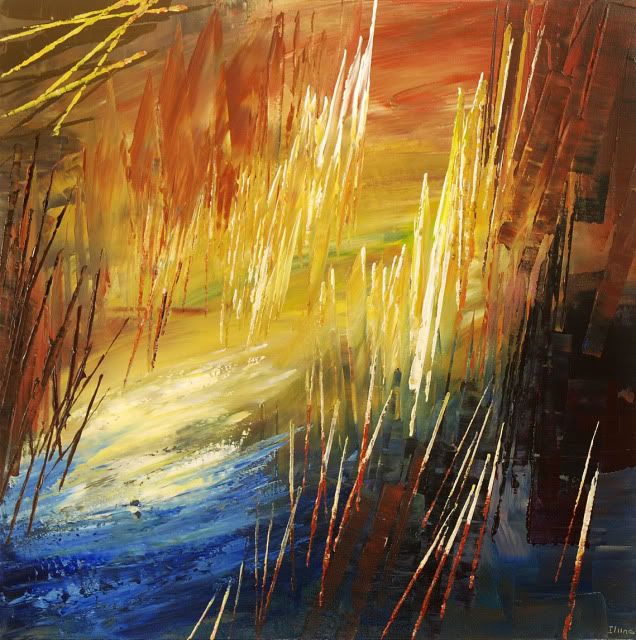
Biosphere1 was the working title of a 2009 abstract painting by Tatiana Iliina that was actually sold to a private collector before its significance was fully established.

As time goes by, the artist reflects and certain trends and turning points in their work become more clear. Indeed, it is a given that the artist's ideas, work, creations and responses sometimes travel in different planes and directions, only to reconvene in different spaces.


In this case, we want to draw the reader's attention to the "Art Biodiversity Workshop" box that was added without comment to the sidebar here a few months ago. With the onset of a fresh, new year, and a chance to pause and reflect, the time feels right to bring up the Biosphere 1 painting and make the perhaps little evident connection between it and the Art Biodiversity Workshop.

As mentioned, no public explanation has been necessary, nor given, for the Art Biodiversity Workshop concept. We see only that it groups a few of our blogs, each of which features paintings from one of Co2-Art partner Tatiana Iliina's ecology-themed collections. These presently include, The Glacier Painter, Industrial Waste Art, Wetlands of the World and After the Deluge.

By bringing the painting shown here into the discussion at this time, the idea is to suggest that 2011 will be a year in which the Art Biodiversity Workshop comes into full bloom and, also, that the world's biospheres are going to have an increasingly vivid role to play as this work unfolds.

Monday, October 11, 2010

Arctic Biodiversity Sympsium Nov. 18-19 at Canadian Nature Museum

One of main events of the International Year of Biodiversity 2010 in Canada will be the Arctic Biodiversity Symposium, to be held Nov. 18-19 at the Canadian Nature Museum in Ottawa.

The symposium, one of seven in Canada listed on the IYB 2010 site, will include presentations incorporating findings gathered during the International Polar Year 2007-2008.

Thursday, June 10, 2010

13 New Biosphere Reserves Added Bring Total to 564 in 109 Countries

The network of Unesco World Biosphere Reserves, with 13 new additions just announced, makes up a vast reservoir of the planet's biodiversity.

The world biosphere system has been in existence for decades, however it is not well known to the general public. In Canada, and, I presume, in most other countries, these reserves are far less well known than the national parks, for example.

It was only when I learned a couple of years ago that Mont Ste-Hilaire, near Montreal, was one of the 15 World Biosphere Reserves in Canada, that I set out to discover more about this system. Suffice to say that I have spent a few hours over several different occasions, looking at the Unesco website linked above and, in short, I still have not gained a concise understanding of how this system works.

I guess the overriding factor in play is that, since the system is worldwide, it is impossible to either impose or agree on worldwide standards, other than certain generalities. Obviously the countries of the world are so diverse in financial means, in values, priorities, cultural outlook, infrastructure, etc., that there would be little hope of creating an easily defined biosphere reserve system.

What I have understood so far is that the system is designed to encourage awareness and preservation of the great biodiversity on the planet. What we see in practice is that, for example, the 15 biosphere reserves designated so far in Canada encompass only a mere sliver of the biodiversity in Canada. So, although 564 reserves worldwide might seem like a lot, and indeed, many of them are impressive, even mind-blowing in their rich natural endowments, we can only assume that the network to-date only scratches the surface of what needs to be put in place.  At least, the existence of the network of World Biosphere Reserves gives us some assurance that our indispensable biodiversity is at least on the radar.

What I find the best way to browse the world biosphere is this link, one of a few different ways to approach it.